
Why local businesses are affected differently
A national retailer may compete on brand recognition, product feeds and thousands of links. A Kent business competes on something more specific.
Google needs to understand:
- What you do
- Where you operate
- Who you help
- Whether customers trust you
- How close you are to the searcher
- Whether your business information is consistent
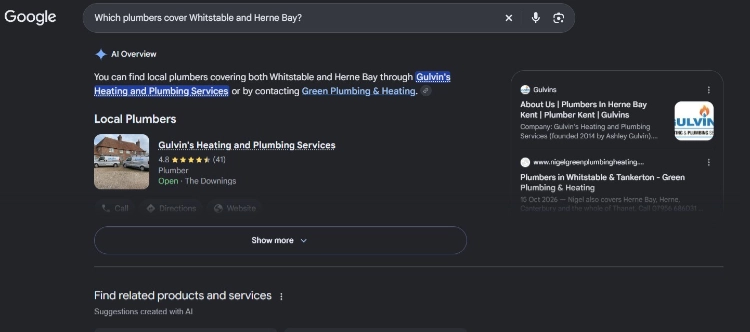
Local search is also more concentrated. The map pack may show only a few businesses. An AI answer may mention even fewer.
That creates pressure. But it can work in your favour.
A genuinely local business with strong reviews, clear services and useful local information can become more visible than a larger competitor with a vague website.

1. Add real depth to your Google Business Profile
Your Google Business Profile is one of your most important local search assets.
It helps Google understand your business as an entity. It also gives customers and AI systems information they can use immediately.
Do not treat it as a listing you create once and forget.
Review every relevant section, including:
- Primary and secondary categories
- Services and service descriptions
- Opening hours and holiday hours
- Business description
- Service areas
- Phone number and website
- Attributes
- Photos of your team, premises and completed work
- Regular updates and posts
If you are a web designer in Kent, do not simply list “web design” as a service. Explain the types of websites you build, the areas you serve and the outcomes you support.
Could a potential customer understand your business without visiting your website?
If not, your profile needs more depth.
Google’s own guidance explains that local rankings are influenced by relevance, distance and prominence. A complete profile supports the first of those factors. It also provides the information people need to choose you.
Read Google’s guidance on how local results are ranked.
2. Build review velocity with honest, specific feedback
Reviews influence trust. They also help Google understand what customers associate with your business.
A profile with 80 reviews from several years ago may not look as active as one receiving genuine reviews every month.
That is why review velocity matters. Aim for a steady flow of honest feedback rather than a sudden rush.
You should also make it easy for customers to describe the service they received. For example, after completing a project, ask:
“Would you be happy to mention the service you used and the area you are based in?”
A customer might naturally write:
“Saxon Internet Solutions helped our Canterbury business improve its website and online visibility.”
That is more useful than a vague review saying, “Great service.”
Do not write reviews for customers. Do not pressure them to use exact keywords. Do not offer incentives in exchange for positive feedback.
Instead:
- Ask every suitable customer at the right time
- Make the review process simple
- Encourage honest detail
- Respond professionally to positive and negative reviews
- Look for recurring themes in customer comments
Are your reviews describing the exact services you want to be found for? If not, your review strategy may need attention.
3. Make your business identity consistent everywhere
AI systems need confidence that different online mentions refer to the same business.
That becomes harder when your details vary across your website, directories, social profiles and map listings.
Check your NAP information:
- Name
- Address
- Phone number
Also check your website URL, business description, opening hours and service areas.
For example, if your address appears as “28 The High Street, Herne Bay” on one platform and “28 High St. herne bay” on another, investigate the difference. Small inconsistencies can create confusion. Google has got better at identifying these small differences but it’s always better to be consistent.
Review:
- Google Business Profile
- Your website contact page
- Bing Places
- Apple Business Connect
- Local Kent directories
- Trade associations
- Facebook and LinkedIn
- Relevant industry directories

This is not about submitting your details to hundreds of low-quality directories. That can create more problems than it solves.
Focus on accurate, relevant and reputable sources.
4. Become the source Google can cite
You want your website to answer questions clearly enough that Google can understand and reference it.
This is where structured data can help. Use appropriate schema such as LocalBusiness, Organization, Service or FAQPage where it genuinely matches the visible content on the page.
But be careful.
There is no magic AI markup. Structured data must be accurate. It must not contain claims that customers cannot see on the page.
Improve your “citability” by:
- Using clear page titles and headings
- Answering one main question per section
- Including concise definitions
- Explaining your process
- Adding evidence of experience
- Linking related pages together
- Keeping important information in text, not only images
- Making sure your website is fast and mobile-friendly
Google’s AI features guidance confirms that normal SEO fundamentals still apply.
Your website does not need to sound robotic. It needs to be clear.
5. Create FAQ content based on real local questions
People do not always search with short keywords.
They ask complete questions:
- “How long does SEO take for a small business in Kent?”
- “Can a web designer in Canterbury help with ecommerce?”
- “Do I need a new website or just better SEO?”
- “How much does local SEO cost for a business in Maidstone?”
- “Can you manage SEO if my business serves several towns?”
These questions are valuable because they reveal intent.
Create FAQ sections on relevant service pages. Answer each question directly. Then add useful context, examples and the next step.
Avoid creating one large page stuffed with dozens of unrelated questions. Keep the content organised.
For example, your SEO service page could answer questions about timescales, reporting, local rankings, reviews and what happens during an audit.
That helps potential customers. It also gives search engines clear passages to understand.
6. Publish local content with genuine specificity
A page that simply changes “London” to “Canterbury” is unlikely to be convincing.
Local content needs real substance.
Mention the areas you genuinely serve. Explain local customer needs. Use real examples. Show photographs of relevant work. Talk about the types of organisations you help.
A Kent-focused article could include useful detail about:
- Serving independent businesses around Canterbury
- Supporting professional firms in Maidstone
- Helping retailers in Ashford
- Working with charities or schools across the South East
- Building websites for businesses in Herne Bay, Whitstable or Sevenoaks
Do not create thin pages for every town just to target keywords.
Ask yourself:
Would a customer in this area learn something useful from this page?
If the answer is no, improve it before publishing.
This is also where your target keyword, seo kent, should be used naturally. Include it in an appropriate heading, paragraph or page title. Do not repeat it unnaturally.
7. Track AI visibility, not just website clicks
A fall in organic clicks does not automatically mean your marketing is failing.
A customer may see your business in an AI answer, check your Google Business Profile, call you directly and never visit your website.
That is still a valuable conversion.
Track a wider set of signals:
- Organic impressions and clicks in Search Console
- Branded searches
- Google Business Profile calls
- Direction requests
- Website enquiries
- Phone call quality
- Map pack visibility
- Review growth
- Queries where your business is mentioned or cited
- Pages appearing in AI features, where reporting is available
Look for patterns.
Are impressions increasing while clicks fall? Are calls rising? Are map interactions improving? Are customers mentioning that they found you through Google?
Your reporting needs to reflect how people now search.

AI search is not the end of local SEO
AI Overviews may reduce some clicks. That is real.
But the businesses that disappear will often be those with incomplete profiles, weak reviews, inconsistent information and generic websites.
The opportunity is to become easier to understand and easier to trust.
Build a strong Google Business Profile. Earn genuine reviews. Keep your business identity consistent. Answer real questions. Publish useful local content. Measure calls and enquiries, not just sessions.
Do this before your competitors do.
If you want a second opinion, Saxon Internet Solutions offers a free, actionable website analysis with no spamming. We can review your website, local visibility and SEO opportunities, then explain what should happen next.
With 27 years of online marketing experience, we focus on websites and marketing that help businesses generate more sales. You can learn more about our search engine optimisation service or contact Saxon Internet Solutions to request your analysis.
Be wary of any SEO company that guarantees a permanent number-one position. No honest provider can control every Google result. What you can expect is a clear strategy, ethical work and measurable progress.